Email:
Info@kinguardfire.comSales & Technical Support:
+852 6330 3016
Email:
Info@kinguardfire.comSales & Technical Support:
+852 6330 3016
Kinguard fire-resistant glass systems are engineered for long-term durability and stable fire performance when integrated into certified door and glazing assemblies.
This technical overview is intended for system manufacturers, fire consultants, and design professionals evaluating fire-resistant glass performance within approved fire-rated systems.
EW classifications provide integrity performance with limited radiant heat transmission, suitable for interior applications prioritizing transparency while controlling heat exposure during fire conditions.
EI classifications indicate both integrity and insulation performance, tested as part of an approved fire-rated system and designed to limit temperature rise on the non-fire side.
Interior Fire-Rated ApplicationsInterior applications introduce additional environmental considerations, including frequent human contact, humidity variation, and chemical exposure from cleaning agents.
Kinguard interior solutions are engineered to address these routine service conditions.
Typical Technical Specifications
| Fire Rating |
Model | Nominal Thickness (mm) |
Glass Build-up (mm) |
Approx. Weight (kg/m²) |
|---|---|---|---|---|
| EW30 | KG-EW30-14-4T KG-EW30-16-5T |
14 16 |
4T+6+4T 5T+6+5T |
28 33 |
| EW60 | KG-EW60-16-4T KG-EW60-18-5T |
16 18 |
4T+8+4T 5T+8+5T |
30 35 |
| EI30 | KG-EI30-18-4T KG-EI30-20-5T |
18 20 |
4T+10+4T 5T+10+5T |
33 38 |
| EI60 | KG-EI60-25-4T KG-EI60-27-5T |
25 27 |
4T+17+4T 5T+17+5T |
41 46 |
| EI90 | KG-EI90-34-5T KG-EI90-36-6T |
34 36 |
5T+24+5T 6T+24+6T |
55 60 |
| EI120 | KG-EI120-40-5T KG-EI120-42-6T |
40 42 |
5T+30+5T 6T+30+6T |
63 68 |
| EI240 | KG-EI240-56-5T KG-EI240-58-6T |
56 58 |
5T+46+5T 6T+46+6T |
83 88 |
Note:
The specifications listed above represent typical reference values based on standard test configurations.
Final glass thickness, structure, and maximum sizes may vary depending on system design, framing method, certification requirements, and applicable fire test reports.
Product selection should always be confirmed as part of a complete certified fire-rated system.
Exterior applications introduce additional environmental variables, including UV exposure, humidity fluctuation, and thermal cycling.
Kinguard exterior solutions are engineered to address these long-term service conditions.
Typical Technical Specifications
| Fire Rating |
Model | Nominal Thickness (mm) |
Glass Build-up (mm) |
Approx. Weight (kg/m²) |
|---|---|---|---|---|
| EW30 | KG-EW30-23-LAM551-6T | 23 | (5T+1+5T)+6+6T | 49 |
| EW60 | KG-EW60-25-LAM551-6T | 25 | (5T+1+5T)+8+6T | 51 |
| EI30 | KG-EI30-27-LAM551-6T | 27 | (5T+1+5T)+10+6T | 54 |
| EI60 | KG-EI60-34-LAM551-6T | 34 | (5T+1+5T)+17+6T | 62 |
| EI90 | KG-EI90-41-LAM551-6T | 41 | (5T+1+5T)+24+6T | 71 |
| EI120 | KG-EI120-47-LAM551-6T | 47 | (5T+1+5T)+30+6T | 79 |
| EI240 | KG-EI240-63-LAM551-6T | 63 | (5T+1+5T)+46+6T | 99 |
Note:
The specifications listed above represent typical reference values based on standard test configurations.
Final glass thickness, structure, and maximum sizes may vary depending on system design, framing method, certification requirements, and applicable fire test reports.
Product selection should always be confirmed as part of a complete certified fire-rated system.
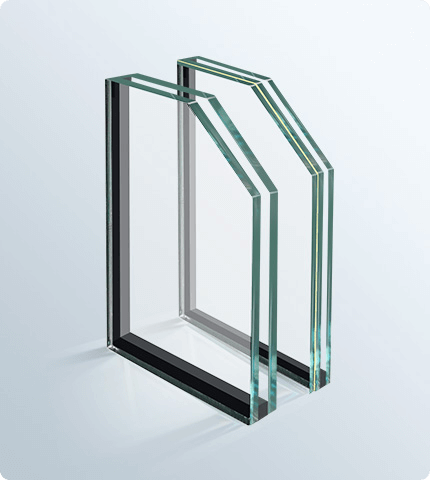
Kinguard fire-resistant glass utilizes a laminated construction incorporating a purpose-engineered fire-resistant interlayer.
The laminated structure is designed for long-term dimensional stability and repeatable performance within certified fire door and glazing systems.
1 . Design Purpose
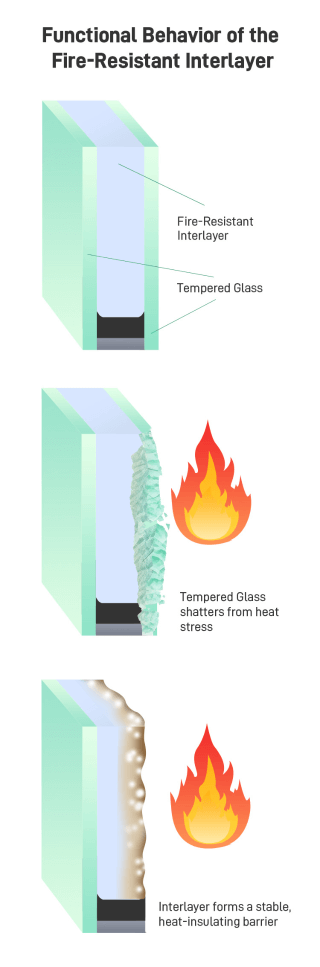
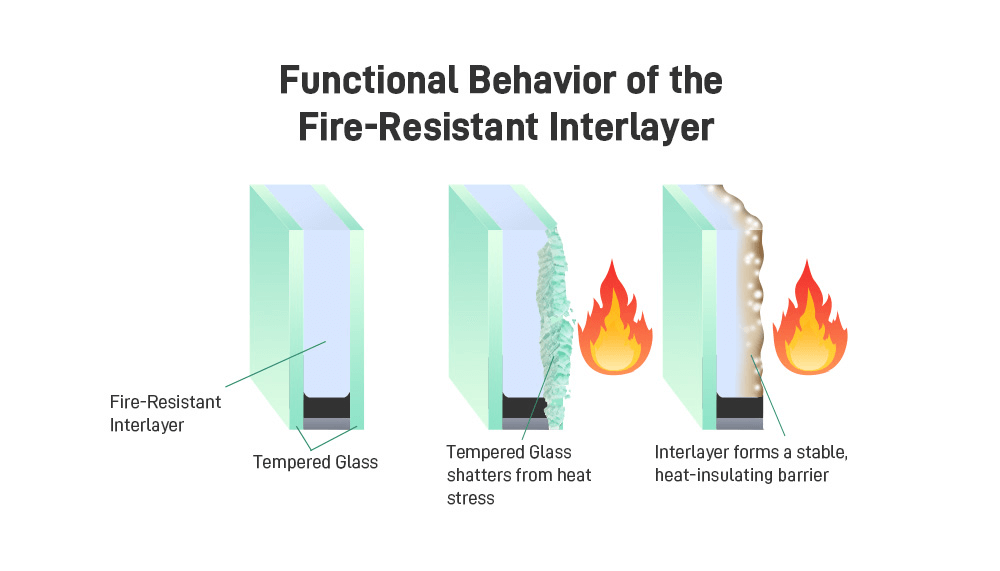
The fire-resistant interlayer is a functional component within the laminated glass assembly, providing insulation performance, thermal protection, and system stability when exposed to fire conditions.
It is engineered to operate as part of a certified fire-rated system, rather than as a standalone material.
2 . Behavior Under Fire Exposure
When exposed to elevated temperatures, the fire-resistant interlayer is designed to:
React to elevated temperatures in a controlled manner
Form an insulating barrier within the laminated structure
Limit heat transmission through the glass assembly
Support integrity and insulation performance for the rated fire duration
This functional response contributes directly to achieving EI fire-rated classifications when tested as part of an approved system.
3 . Integrated Laminated Structure
The interlayer is permanently laminated between tempered glass plies, forming a stable and sealed composite structure.
This integrated design ensures:
Predictable performance during fire exposure
Structural integrity within door and glazing assemblies
Compatibility with certified glazing methods
Long-term optical stability under normal service conditions
4 . Stability & Durability Considerations
Kinguard interlayer design prioritizes long-term service performance, including:
Resistance to optical degradation over time
Stability under temperature and humidity variations
Consistent behavior across production batches
This approach supports long-term use in fire door vision panels without reliance on complex multi-layer constructions.
5 . System Integration
Fire-resistant interlayers are intended for use:
Within laminated fire-resistant glass
Supplied through certified fire door or glazing systems
In accordance with approved test evidence and glazing specifications
Final fire performance and long-term durability depend on complete system design, including framing, glazing methods, and certified configurations.
Fire-resistant glass performance cannot be evaluated by fire testing alone.
Long-term reliability depends on material behavior, system integration, and service-life stability beyond initial certification.
This engineering philosophy defines the Kinguard EW and EI series.